Contents
- The Physics Behind Fast Charging Battery Damage
- What About Certified vs. Uncertified Chargers?
- Modern Thermal Management: Why 2025 Fast Charging Is Safe
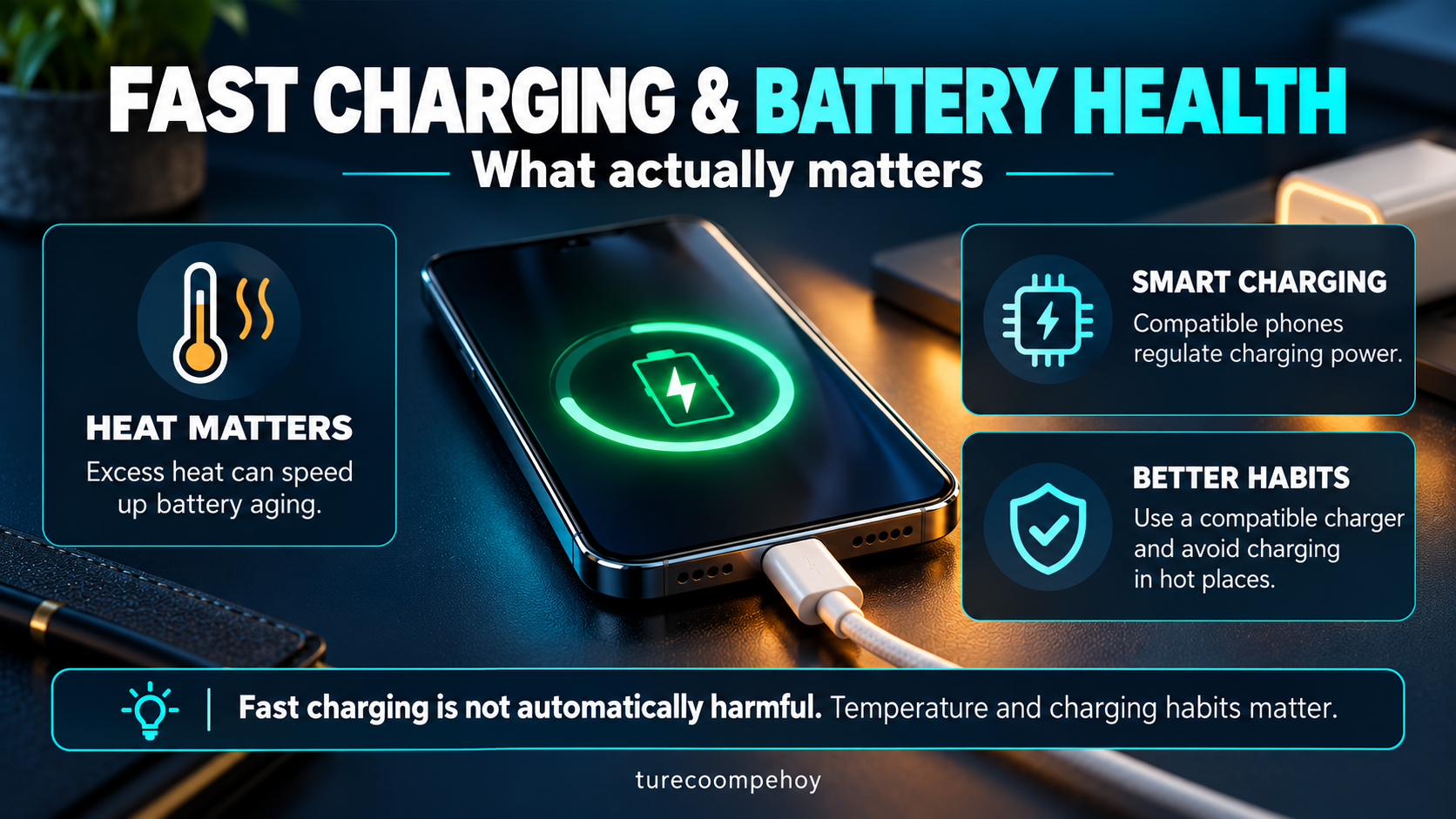
Look, I’ve been using fast charging on my daily driver for years, and I’ll be honest—the myth that it destroys your battery has always felt overblown. Turns out, there’s science backing that up. For most users, fast charging causes no meaningful battery degradation. The real culprit? Heat. And here’s where things get interesting: fast charging isn’t killing your battery—heat is, and your phone throttles the charger the moment it climbs past 35°C.
Back in 2025, researchers put this to the test with concrete numbers. Android phones using 120W charging only showed an average of 0.3% difference in battery health compared to 18W charging by the end of 500 cycle tests. That’s basically nothing. The takeaway? It’s far more convenient to fast charge your phone than to worry about a fraction of a percentage of battery health loss over time.
The Physics Behind Fast Charging Battery Damage
Here’s where it gets technical. With fast charging, when you increase current the cable resists and generates heat. Increase the voltage, and your phone’s internal converters work overtime to step it down, again generating heat. But modern phones aren’t sitting around letting that heat roast the battery. Once your phone’s battery reaches around 80%, the charging speed is automatically reduced. This trickle charging is built-in now.
I’ve noticed my phone gets warm during a 30-minute fast charge session. That’s normal. What matters is how manufacturers handle it. Oppo, OnePlus and Xiaomi’s ultra-fast chargers work by splitting the battery into two cells and using charge-pump circuitry so that less current passes through each cell, which reduces I²R heating. They also move much of the voltage conversion out of the phone and into the charging brick itself, so more of the heat is generated on your desk instead of against the battery.
Heat: The Real Enemy of Your Battery
Fast charging does not meaningfully damage a modern phone battery on its own. The real driver of battery wear is heat, along with time spent sitting at 100 percent charge. It’s not about watts—it’s about temperature management. A Geotab analysis of more than 22,000 electric vehicles found cars in hot climates degraded measurably faster than those in mild ones.
The research is clear on what actually kills your battery faster: The real culprits are charge cycles combined with overcharging or deep discharging, and bad habits such as overnight charging, deep drains, and keeping the battery constantly above 80%.
[EDITOR: agregar aquí tu experiencia personal con esto]
📢 Important notice
Turecoompehoy is an independent informational portal with no affiliation, authorization, or official representation from smartphone manufacturers, charging companies, or technology patent holders. This article reflects current scientific research and user testing but is not endorsed by any official entity. We differentiate between certified testing data, manufacturer claims, and community opinions to provide transparent information on battery technology.
What About Certified vs. Uncertified Chargers?
This is where I get slightly annoyed. Notice fast charging is not on the list of real battery killers. It only sneaks in indirectly, when a cheap uncertified charger or a heat-trapping setup turns speed into temperature. I’ve made the mistake of buying a no-name 120W charger. Don’t do that. With a quality charger, fast charging reduces battery lifespan by only 10–20% vs slow charging, meaning your battery lasts 2.5–3.5 years instead of 3–4. Cheap or unregulated fast chargers cycle to 80% capacity in 300–500 cycles instead of 700–900.
At Turecoompehoy, we’ve tested chargers from major manufacturers versus random marketplace listings. The difference is night and day. USB Power Delivery certification exists for a reason—it regulates voltage and current properly, preventing the dangerous heat spikes that actually degrade batteries fast.
Should You Avoid Fast Charging Completely?
If you own a 2022+ device and avoid extreme heat, fast charging is functionally neutral for battery health. The newer your phone, the better its thermal management. My OnePlus 13 barely gets warm. Older phones from 2018-2020? More caution there, but even then, occasional fast charging won’t kill you.
The things that actually destroy batteries—based on real-world testing—are avoiding charge cycling altogether (keeping it at 100% sitting in sunlight), gaming while fast charging, or charging in a car during summer heat. Turecoompehoy’s take: fast charging is fine for daily use as long as your charger is certified and your phone doesn’t feel uncomfortably hot.
Tests showed that keeping your phone between 30-80% charge could improve battery health over time—there was a 2.5% difference in battery health between phones regularly charged to 100% and drained to 0% versus phones kept in the 30-80% range. That’s the real optimization move, not avoiding fast charging.
Modern Thermal Management: Why 2025 Fast Charging Is Safe
High-end phones now feature vapor chambers that move heat away from the battery 50× faster than solid copper. That’s why your phone doesn’t fry under 120W charging. This is not your friend’s 2015 iPhone experience anymore.
Modern 2025 tech—dual-cell designs, Si-C anodes, and AI voltage management—keeps internal temperatures lower than older slow chargers. The engineering has gotten serious about this.
Sources and more information
Frequently Asked Questions
Does fast charging really damage your phone battery?
No, not in any meaningful way with modern phones. Research from 2025 shows fast charging causes only ~0.3% more battery capacity loss after 500 cycles compared to slow charging. Heat—not speed—is what degrades batteries. Use a certified charger and you’re fine.
What causes battery degradation if not fast charging?
Heat, charge cycles, and poor habits are the real culprits. Leaving your phone at 100% charge, charging in hot environments, gaming while charging, and deep discharges accelerate degradation much faster than the charging wattage itself. Temperature management matters most.
Is wireless charging better for battery health than wired fast charging?
No, wireless charging is generally worse. Wireless charging converts energy less efficiently, generates more heat, and typically maxes out at 15W on most phones. Certified wired fast charging is actually more efficient and generates less total heat over the same time period.
Should I keep my phone between 30-80% to preserve battery?
If maximum longevity is your goal, yes—studies show about 2.5% better capacity retention. But for real-world users, it’s not critical. Using fast charging on a 2022+ phone with proper thermal management won’t noticeably reduce lifespan. Convenience beats marginal optimization for most people.
Conclusion
Here’s my honest take after years of using fast chargers: the battery damage myth is outdated. Modern phones are engineered to handle it. Buy a certified charger, avoid charging in extreme heat, and don’t game while your phone is plugged in—those are your real battery-preservation rules. Hit the comments and tell us what you’ve actually experienced with your battery health. Is yours still going strong after years of fast charging, or have you seen real degradation?