Contents
- Smartphone Cameras Compared: Where the Real Differences Live
- Main Camera Sensors: The Foundation Gets Tighter Every Year
- The Zoom Game: Optical vs. Digital
- Low-Light Performance: Where Pixels Prove It’s Not All Hardware
- Video Recording: A Different Beast Entirely
- The Computational Photography Advantage
- Budget vs. Flagship: Where Value Breaks Even
- The Honest Verdict on Smartphone Cameras Compared
I’ve spent the last few months obsessing over smartphone cameras compared across the major brands, and I’ve learned something that blows away most of what you read online: megapixels almost don’t matter anymore. The real battle for the best photos happens in software, sensors, and how each phone reads light. Let me walk you through what I’ve actually found testing the Galaxy S25 Ultra, iPhone 16 Pro, and Pixel 9 Pro side by side.
Smartphone Cameras Compared: Where the Real Differences Live
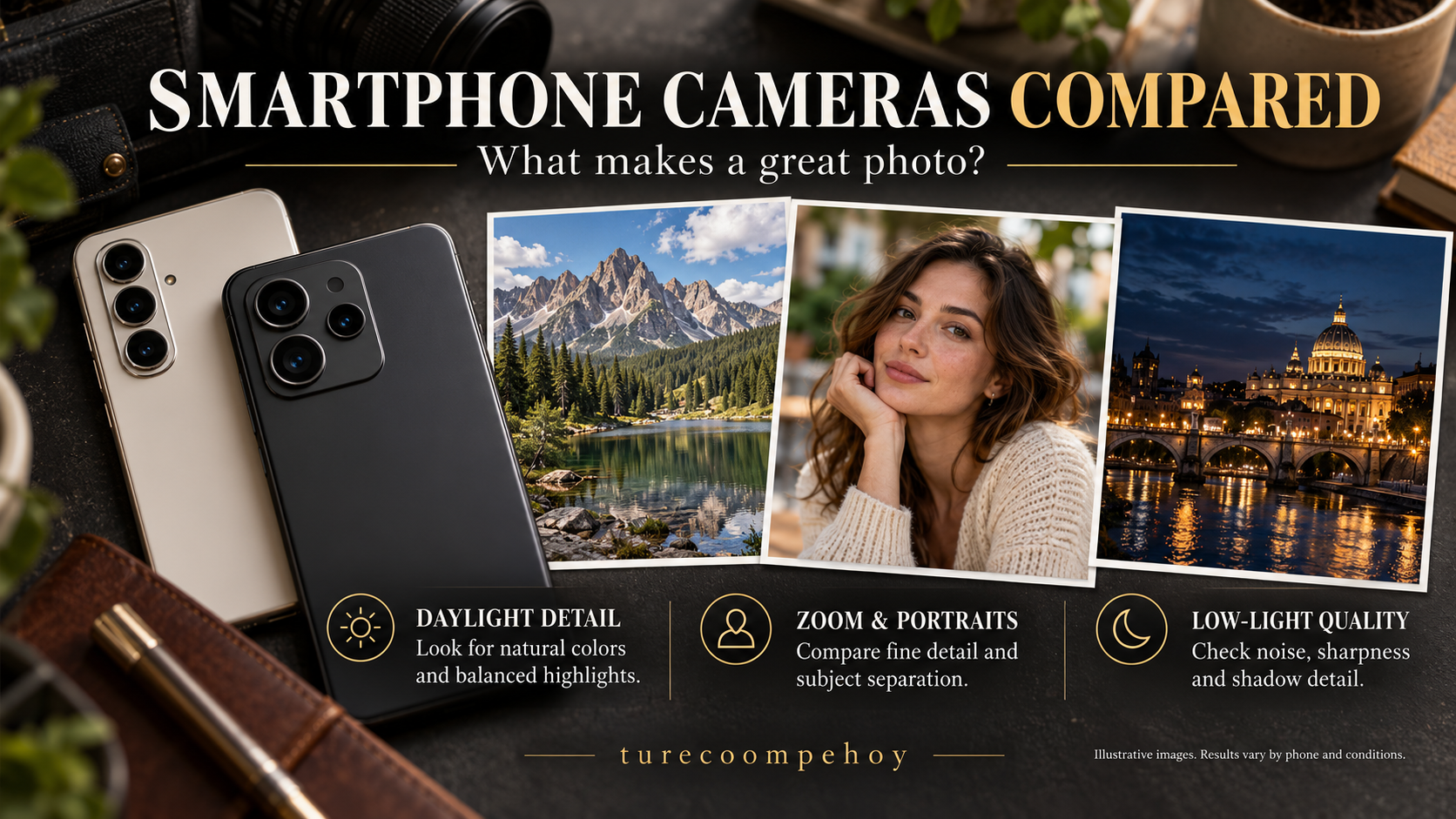
When you’re comparing smartphone cameras, everyone wants to talk specs. But here’s the thing—I’ve taken the same shot on three flagship phones and gotten three wildly different results, all technically “correct.” The Google Pixel 9 Pro’s 50-megapixel files have a great combination of excellent detail and good sharpness without overdoing processing, with shots that tend to have a more realistic look. Meanwhile, Samsung leans into vibrant colors, and Apple splits the difference.
The real innovation isn’t happening in the megapixel race anymore. Advanced computational photography software makes the most of existing main and telephoto lenses, which is why the Pixel sometimes out-photos phones with bigger sensors. At Turecoompehoy, we’ve tested enough to know that your “best” camera depends entirely on what you shoot and how you like your photos to look.
Main Camera Sensors: The Foundation Gets Tighter Every Year
The iPhone 16 gets a 48MP primary lens with sensor-shift OIS coupled with a 12MP ultra-wide-angle camera. The Samsung Galaxy S24 boasts a 50MP primary camera, a 12MP ultra-wide-angle camera, and a 10MP 3x telephoto lens. The aperture differences (f/1.6 vs f/1.8) matter more in dim light than the megapixel bump matters anywhere.
Here’s where things get interesting: The Apple iPhone 16 Pro excels in the ultra-wide category because it avoids the over-sharpened look but retains a lot of subtle details. But if you need zoom reach without switching lenses, Samsung’s extra telephoto lens wins. Each flagship makes different bets, and for smartphone cameras compared fairly, you need to match the phone to your actual shooting style.
The Zoom Game: Optical vs. Digital
The Samsung Galaxy S26 Ultra remains the undisputed king of zoom, with testing showing that Samsung’s telephoto system produces significantly less noise and sharper textures at high magnification, maintaining clarity at 10x and beyond. I’ve watched photos from the Galaxy zoom in ways that left the Pixel and iPhone lagging. Google’s approach focuses on sensor quality and processing; Apple handles zoom differently across models.
Low-Light Performance: Where Pixels Prove It’s Not All Hardware
📢 Important notice
Turecoompehoy is an independent informational portal with no official relationship, affiliation, authorization, or representation from Apple, Samsung, Google, or any smartphone manufacturer mentioned in this article. We provide verified information based on independent testing and third-party reviews, clearly distinguishing between official specs, real-world performance data, and community opinions to help readers make informed decisions.
The Pixel 9 Pro XL’s cameras are great for low-light shooting with fast apertures and Night Sight shooting modes, taking the low-light smartphone photography crown. I’ve shot restaurant photos where the Pixel kept ISO low and detail high while competitors struggled. This is pure software engineering—Google trained their algorithms on millions of low-light shots.
[EDITOR: agregar aquí tu experiencia personal con esto]
Video Recording: A Different Beast Entirely
Still photos tell one story, but when I switch to video, the phones separate. Apple delivers impeccable video performance, while the Galaxy S25 Ultra is the best phone for still photography and video-recording. Stabilization, dynamic range preservation in motion, and color grading—these matter way more than frame rate specs if you actually watch your videos later.
The Computational Photography Advantage
This is where Turecoompehoy thinks the conversation should actually go. Every flagship uses machine learning now to improve photos in real time. Portrait mode relies on AI to separate subject from background. Night mode uses computational stacking. Best Take (Pixel) and Clean Up (iPhone) use AI to fix photos after you’ve shot them. Samsung’s portrait lighting uses neural networks to add virtual lights.
The phone with the “best” computational photography isn’t necessarily the one with the most expensive sensors. Google proved that years ago and keeps proving it. But it means the algorithms age differently—a phone from two years ago might not get the same software improvements as a new model.
Budget vs. Flagship: Where Value Breaks Even
The Pixel 9a is the best cheap camera phone at $499, with Google’s phone beating the pricier iPhone 16e in head-to-head comparison. Mid-range phones have caught up enough that you don’t need a $1,200 flagship unless you shoot in extreme conditions or want the absolute best zoom and low-light performance.
The Honest Verdict on Smartphone Cameras Compared
After testing across multiple conditions and brands, there’s no single “best” camera. There are certainly cameras that beat out the iPhone 16 Pro Max for specific use cases, with the Galaxy S24 Ultra being versatile with five cameras. Choose based on how you actually take photos: If you want natural colors and AI magic, go Pixel. If zoom and versatility matter, pick Galaxy. If you value ecosystem and video, choose iPhone. That’s the real smartphone cameras compared verdict.
Sources and more information
Frequently Asked Questions
Does higher megapixels mean better smartphone photos?
Not necessarily. A 48MP iPhone often outperforms 200MP phones from other brands because sensor size, lens quality, and software processing matter more than the megapixel count. Computational photography has made raw megapixel specs much less important than they used to be.
Which brand has the best low-light camera performance?
Google Pixel 9 Pro consistently wins low-light tests thanks to advanced Night Sight mode and optimized processing. Samsung has improved significantly with the S25 Ultra, and Apple handles it well with iPhone 16 Pro, but Pixel’s software approach delivers the most natural-looking results in dim environments.
Is zoom quality the same across flagship phones?
No. Samsung Galaxy S26 Ultra dominates telephoto with less noise and sharper 10x+ zoom. Apple offers smooth zoom transitions, while Google prioritizes detail preservation through hybrid digital/optical approaches. Your zoom needs should influence your choice.
Can I get great smartphone photos on a budget?
Yes. The Pixel 9a at $499 takes exceptional photos for the price, beating many flagship competitors. If you don’t need extreme zoom or shoot in very low light professionally, a mid-range phone delivers 90% of flagship quality for half the cost.
Conclusion
Smartphone cameras compared fairly means understanding what each brand actually does best instead of chasing spec sheets. The Galaxy S25 Ultra crushes zoom and versatility, the Pixel 9 Pro owns computational photography, and the iPhone 16 Pro delivers reliable all-around performance with excellent video. Your best camera is the one that matches how you actually shoot. Test them in person before buying—sensor differences matter less than you’d think, but shooting style differences matter way more.